20 years of BHL: A Snapshot
Since its founding in 2006, the Biodiversity Heritage Library has evolved from a small consortium of ten founding institutions into a global, community-governed digital infrastructure supporting biodiversity research worldwide. Established to address longstanding barriers to access to natural history literature, BHL has expanded far beyond its original scope, building global partnerships, shared infrastructure, and data-driven services that support discovery, interoperability, and reuse across research ecosystems.
Over its first two decades, BHL has grown into the world’s largest open access digital library for biodiversity literature, providing free access to nearly 64 million pages and serving over 16 million users in more than 240 countries and territories. In 2026, BHL entered a new chapter as a fully distributed, community-governed organisation, continuing its long-standing commitment to open access, collaboration, and the shared stewardship of biodiversity knowledge.
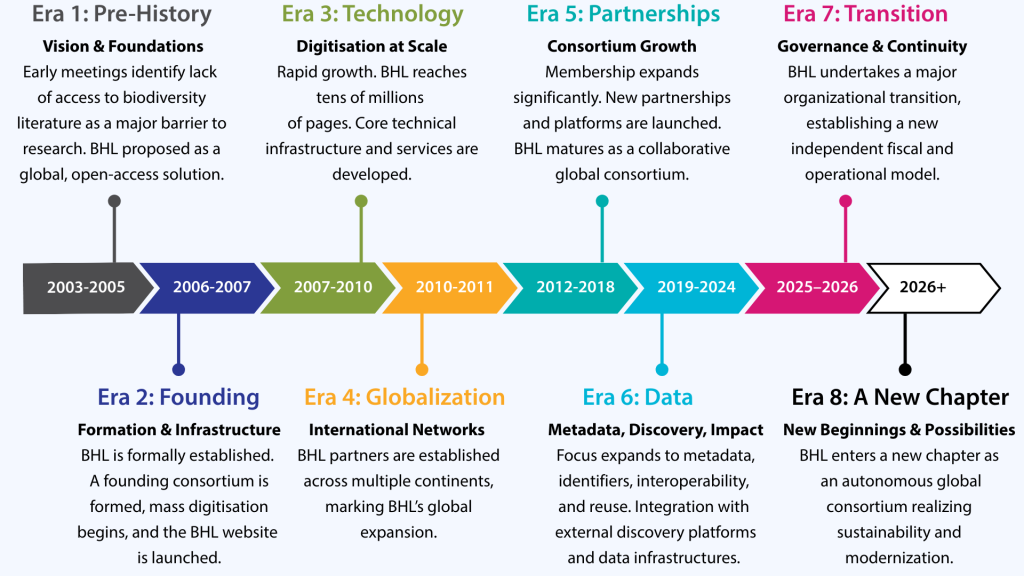
The Eras of BHL
Era 1: Pre-History | 2003–2005 | Vision & Foundations
Early meetings identify lack of access to biodiversity literature as a major barrier to research. BHL proposed as a global, open-access solution.
Era 2: Founding | 2006–2007 | Formation & Infrastructure
BHL is formally established. A founding consortium is formed, mass digitisation begins, and the website is launched.
Era 3: Technology | 2007–2010 | Digitisation at Scale
Rapid growth. BHL reaches tens of millions of pages. Core technical infrastructure and services are developed.
Era 4: Globalization | 2010–2011 | International Networks
BHL partners are established across multiple continents, marking BHL’s global expansion.
Era 5: Partnerships | 2012–2018 | Consortium Growth
Membership expands significantly, new partnerships and platforms are launched. BHL matures as a collaborative global consortium.
Era 6: Data | 2019–2024 | Metadata, Discovery, Impact & Reuse
Focus expands to metadata, identifiers, interoperability, and reuse. Integration with external discovery platforms and data infrastructures.
Era 7: Transition | 2025–2026 | Governance & Continuity
BHL undertakes a major organizational transition, establishing a new independent fiscal and operational model.
Era 8: A New Chapter | 2026+ | New Beginnings & Possibilities
BHL enters a new chapter as an autonomous global consortium realizing sustainability and modernization.
A Detailed History of BHL
Era 1: Pre-History (2003–2005) | Vision & Foundations
The Biodiversity Heritage Library was created to address a major obstacle to scientific research: limited access to natural history literature. This literature underpins research worldwide, providing species data and descriptions, ecological observations, distribution records, geological and climatic data, and other foundational information essential to understanding biodiversity.
In 2003, at a meeting funded by The Andrew W. Mellon Foundation, scientists identified free, online access to biodiversity literature as a critical need for improving the efficiency and effectiveness of global research. The following year, the 2004 Telluride Institute symposium proposed the creation of the Encyclopedia of Life. These discussions culminated in the 2005 meeting Library and Laboratory: The Marriage of Research, Data, and Taxonomic Literature, organised by the Consortium for the Barcode of Life with support from the Alfred P. Sloan Foundation and the National Biological Information Infrastructure of the U.S. Geological Survey, and hosted at the Natural History Museum in London.
Era 2: Founding (2006–2007) | Formation & Infrastructure
In 2006, these conversations led to an organisational meeting at the Smithsonian Libraries, where the Biodiversity Heritage Library was formally established. At its founding, BHL comprised ten member institutions in the United States and the United Kingdom:
- American Museum of Natural History
- The Field Museum
- Harvard University, Botany Libraries
- Harvard University, Museum of Comparative Zoology
- Marine Biological Laboratory | Woods Hole Oceanographic Institution (MBLWHOI)
- Missouri Botanical Garden
- Natural History Museum, London
- The New York Botanical Garden
- Royal Botanic Gardens, Kew
- Smithsonian Libraries
In 2007, Tom Garnett, then Associate Director of Smithsonian Libraries, was appointed Program Director, and the Smithsonian assumed administrative responsibility for the program, establishing the BHL Secretariat.
Initial funding for BHL came from a range of philanthropic and institutional sources. In 2006, the Richard Lounsbery Foundation supported development of a Union Catalogue to enable large-scale digitization work. Substantial funding was also provided through a MacArthur Foundation grant to the Encyclopedia of Life (EOL), within which BHL served as the literature digitization component. This funding enabled mass digitization across partner libraries and supported technical infrastructure and staffing.
Era 3: Technology (2007–2010) | Digitisation at Scale
From 2007 to 2010, BHL focused on building the technical infrastructure required to support mass digitisation and discovery. Technical operations were led by the Missouri Botanical Garden under the guidance of Technical Director Chris Freeland.
The Internet Archive was selected as BHL’s digitisation partner, enabling rapid growth in scanned volumes and pages. The BHL website launched in May 2007 with just over 300 titles, marking the beginning of large-scale public access to biodiversity literature. By mid 2010, BHL’s collection had surpassed 3 million pages.
New tools and workflows were introduced, including user feedback systems and scan request features, allowing users to nominate materials for digitisation. BHL also launched its blog, creating a direct channel for communicating with users and partners as the collection and consortium expanded.
Era 4: Globalization (2009–2011) | International Networks
BHL’s international footprint expanded rapidly with the establishment of global partners. BHL Europe was launched in January 2009 through the European eContentplus programme, followed in December 2009 by BHL Egypt in partnership with the Bibliotheca Alexandrina. In 2010, BHL China was established by the Chinese Academy of Sciences, BHL Australia was formed as an outgrowth of the Atlas of Living Australia under the leadership of Museums Victoria, and BHL SciELO launched in Brazil, marking BHL’s first South American presence.
This era marked a shift from a primarily US- and UK-based collaboration to a global network. BHL Australia’s website later informed the design of the unified BHL platform, reflecting the collaborative exchange of expertise across regions. Additional partners were later established in Africa (2013, with funding from the JRS Biodiversity Foundation), Singapore (2014, established in partnership with the National Library Board, Singapore), and Mexico (2014, led by La Comisión Nacional para el Conocimiento y Uso de la Biodiversidad (CONABIO)).
This era also saw an expansion of public engagement and discovery platforms. BHL launched presences on Twitter and Facebook in 2009, followed by Flickr in 2011, broadening access to its collections and reaching new audiences beyond traditional research communities. The Field Book Project launched in 2010, adding a significant body of archival field notes and correspondence to BHL’s collections.
Era 5: Partnerships (2012–2018) | Consortium Growth
From 2012 onward, BHL experienced significant growth in membership, partnerships, and services. Martin R. Kalfatovic, Associate Director of Digital Programs and Initiatives at Smithsonian Libraries, began his 12 year tenure as BHL Program Director in 2012, and William Ulate served as Technical Director from 2012 to 2015. Over time, BHL’s technical development evolved into a distributed model supported by Technical Advisors drawn from partner institutions.
Following the conclusion of MacArthur Foundation funding in 2013, BHL adopted a more diversified membership and governance model, strengthening its long-term sustainability. A new BHL website launched in 2013, based on the BHL Australia design, reflecting the maturation of both the platform and the consortium.
During this era, BHL joined the Global Biodiversity Information Facility (GBIF), signed the Bouchout Declaration, and undertook numerous grant-funded initiatives in collaboration with partners. These included Art of Life (2012-2015); Purposeful Gaming (2013-2015); Mining Biodiversity: Enriching the Biodiversity Heritage Library with Text Mining and Social Media (2014-2016); Expanding Access to Biodiversity Literature (2015-2017); Foundations to Actions: Extending Innovations in Digital Libraries in Partnership with NDSR Learners (2016-2018); and the Field Notes Project (2016-2018). BHL also hosted a National Digital Stewardship Residency cohort with support from the Institute of Museum and Library Services (IMLS) and received the Digital Library Federation’s 2016 Community/Capacity Award.
In 2015, a new species of land snail was named in honour of BHL: Vargapupa biheli, and in 2016, celebrated its 10th anniversary and the milestone of reaching its 50 millionth digitised page.
Era 6: Data (2018–2024) | Metadata, Discovery, Impact & Reuse
As the collection matured, BHL increasingly focused on enhancing the discoverability, interoperability, and reuse of its content. This included the launch of full text search, the expansion of article-level metadata and persistent identifiers, and functionality allowing the upload of transcriptions for handwritten items.
BHL strengthened its integration with major discovery and data platforms, including Unpaywall, WorldCat, Wikimedia, and GBIF, ensuring that biodiversity literature could be more easily found and reused across research ecosystems. In 2020, BHL launched its Persistent Identifier Working Group and, in 2022, enabled downloadable Article PDFs. In 2023, BHL published a Wikimedia white paper: Unifying Biodiversity Knowledge to Support Life on a Sustainable Planet. In 2024, BHL datasets were made openly accessible via the Registry of Open Data on Amazon Web Services and BHL signed the Disentis Roadmap.
During this period, released both a new Collection Development Policy and an Acknowledgment of Harmful Content, recognising that some historical materials in the collection reflect harmful and exclusionary perspectives. This work formed part of BHL’s broader commitment to transparency, equity, and responsible stewardship of historical content.
In 2019, a new species of fossil fly was named in honor of BHL: Kishenehnoasilus bhl. In 2022, BHL’s collection surpassed 60 million pages, reflecting both the scale and diversity of the literature it preserves.
Era 7: Transition (2025–2026) | Governance & Continuity
In 2025, the Smithsonian Institution announced its intention to conclude its long-standing role as BHL’s administrative host. In response, the BHL consortium initiated a coordinated, community-led transition focused on governance, funding, and long-term sustainability. This work included a global Call for Support, and a public fundraising campaign, which generated financial and in-kind support from across the BHL community enabling the transition to proceed with increasing confidence and stability over the course of the year.
In 2026, in its 20th anniversary year, BHL entered a new operational chapter, adopting a fully distributed organisational model with fiscal sponsorship provided by the Council on Library and Information Resources (CLIR). This transition built on nearly two decades of collaboration and positioned BHL as a resilient, community-governed global digital infrastructure.
Era 8: A New Chapter (2026+) | New Beginnings & Possibilities
Stay tuned to the latest BHL news.